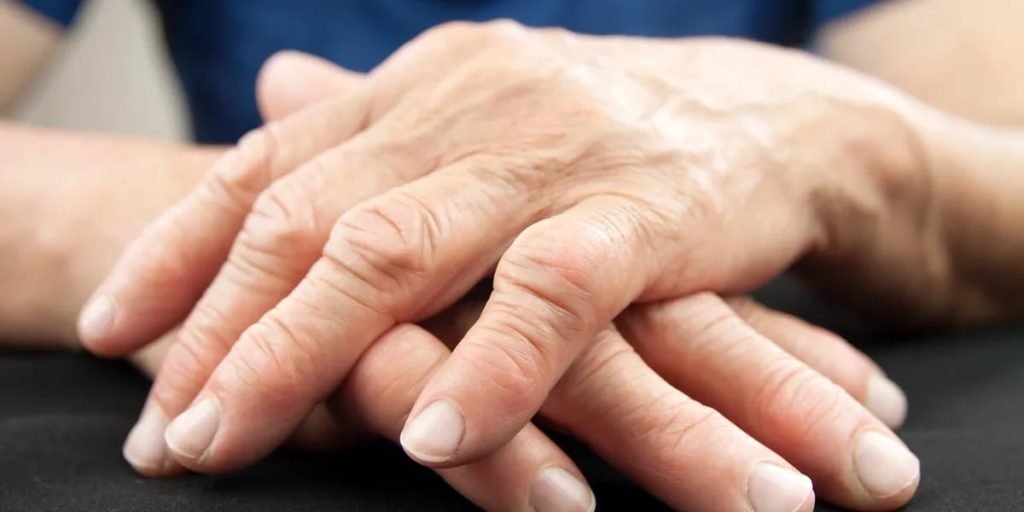
At a glance
- Also known as
- RA, Rheumatoid disease
- ICD-10
- M05–M06
- Key symptoms
-
- Pain, swelling and warmth in the joints, most often the fingers, wrists and toes
- Stiffness in the morning lasting longer than 30 minutes
- The same joints affected on both sides of the body
- Tiredness that does not improve with rest
- Firm lumps under the skin near the elbows or fingers, called nodules
Overview
Rheumatoid arthritis is a long-term condition in which the immune system attacks the joints. The immune system normally defends the body against infection. In rheumatoid arthritis it mistakenly targets healthy tissue, and the thin lining inside the joint — the synovium — becomes inflamed, thickened and painful.
It usually starts in the small joints of the hands and feet, and characteristically affects the same joints on both sides of the body. Because the inflammation is driven by the immune system rather than by wear, it can also affect other parts of the body, including the eyes, lungs and blood vessels.
Rheumatoid arthritis is not the same as osteoarthritis. Osteoarthritis comes from changes to the joint surfaces over time; rheumatoid arthritis comes from immune activity, and the treatments are different.
Untreated inflammation can damage cartilage and bone permanently. Treated early, most people can expect the disease to be brought under control and joint damage largely prevented, which is why getting a diagnosis promptly matters more here than in many other joint conditions.
Symptoms
The most common early symptoms are pain, swelling and warmth in the small joints of the hands and feet, with stiffness that is worst in the morning or after sitting still. Morning stiffness that lasts more than half an hour is a useful distinguishing feature — stiffness from wear usually eases within a few minutes.
Many people also feel generally unwell, with tiredness, mild fever or loss of appetite. These whole-body symptoms are part of the condition and not separate from it.
Symptoms often fluctuate. A period of increased disease activity is called a flare.
Causes
The cause is not fully understood. Rheumatoid arthritis develops when an inherited susceptibility combines with something in the environment that triggers the immune system.
Having a close relative with the condition raises the risk, but most people with rheumatoid arthritis have no affected relative, and most people with a family history never develop it. Smoking is the most clearly established environmental risk factor, and it also makes the condition harder to treat.
It is not infectious, and nothing a person did caused it.
Diagnosis
There is no single test that confirms rheumatoid arthritis. The diagnosis is made by putting together the pattern of symptoms, an examination of the joints, blood tests and, where useful, imaging.
What the pattern looks like over time is often as informative as any one result. Blood tests can be normal in early disease, and a normal result does not rule the condition out. Equally, the antibodies associated with rheumatoid arthritis are sometimes found in people who never develop it.
Formal classification criteria exist, developed jointly by the American College of Rheumatology and EULAR. They were designed mainly to make research groups comparable rather than to diagnose an individual, and a rheumatologist may diagnose and treat someone who does not meet them.
Investigations
Blood tests commonly used include rheumatoid factor and anti-CCP antibodies, which are immune proteins associated with the condition, and markers of inflammation such as ESR and CRP. Anti-CCP is the more specific of the two antibodies.
Imaging may include X-rays, ultrasound or MRI. Ultrasound and MRI can show inflammation before it appears on an X-ray.
Before starting long-term medication, blood counts and tests of liver and kidney function are usually checked, and repeated periodically afterwards. This monitoring is routine.
Treatment
The aim of treatment is remission — no active inflammation — or, where that is not achievable, the lowest disease activity possible. Treatment is adjusted at intervals until that target is reached, rather than left unchanged while symptoms continue. This approach is called treat-to-target.
The main treatments are disease-modifying antirheumatic drugs, usually shortened to DMARDs. These act on the underlying immune process rather than only relieving pain. Current European guidance recommends starting methotrexate as the first DMARD in most people, often alongside a short course of steroid while it takes effect.
If the response is not adequate after a few months, a biological or targeted synthetic DMARD may be added. These are newer medicines that block specific parts of the immune response.
Steroids are effective but are used for the shortest period reasonable, because long-term use carries its own risks. Anti-inflammatory painkillers may help symptoms but do not slow joint damage, so they are not a substitute for a DMARD.
Which medicine suits a particular person depends on disease activity, other medical conditions, plans for pregnancy, and personal preference. That decision belongs in a consultation, not on a webpage.
Lifestyle
Stopping smoking is the single most useful change. It reduces disease activity, improves how well treatment works, and lowers cardiovascular risk, which is raised in rheumatoid arthritis.
Keeping moving helps. Exercise does not wear the joints out; inactivity weakens the muscles that protect them. A physiotherapist can help find a level that suits current disease activity.
Because inflammation affects the heart and blood vessels as well as the joints, blood pressure, cholesterol and diabetes are worth attention. Bone protection and vaccinations are also usually discussed, particularly for anyone taking steroids or medicines that suppress the immune system.
Frequently asked questions
Will I need to take medication for the rest of my life?
Often, yes — but not always the same medication or the same amount. Rheumatoid arthritis is a long-term condition, and treatment keeps it controlled rather than curing it. If the disease stays in remission for a sustained period, it is sometimes possible to reduce treatment carefully under supervision. Stopping suddenly and without advice usually leads to a flare.
Is rheumatoid arthritis hereditary?
There is an inherited component, so having a close relative with the condition raises the risk. It is not passed on directly, though. Most people with rheumatoid arthritis have no affected relative, and most people with a family history never develop it.
Can diet cure it?
No diet has been shown to cure rheumatoid arthritis. A balanced diet supports general health, weight and heart health, all of which matter here. Be cautious of anything sold as a cure, particularly if it involves stopping prescribed treatment.
Should I rest the joint or exercise it?
Both, at different times. During a flare, an inflamed joint benefits from rest. Between flares, regular movement protects the joint by keeping the surrounding muscle strong. A physiotherapist can help you judge the balance.
References
- EULAR recommendations for the management of rheumatoid arthritis with synthetic and biologic disease-modifying antirheumatic drugs: 2025 update View source (opens in a new tab)
- Rheumatoid arthritis in adults: management (NG100) View source (opens in a new tab)
- 2010 Rheumatoid Arthritis Classification Criteria: an American College of Rheumatology/European League Against Rheumatism collaborative initiative View source (opens in a new tab)